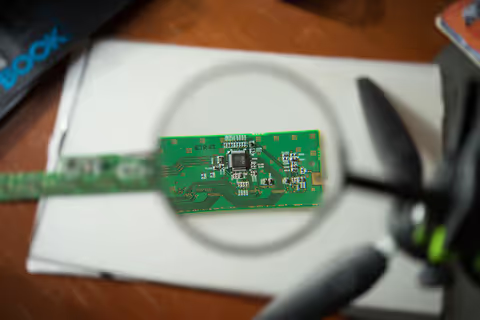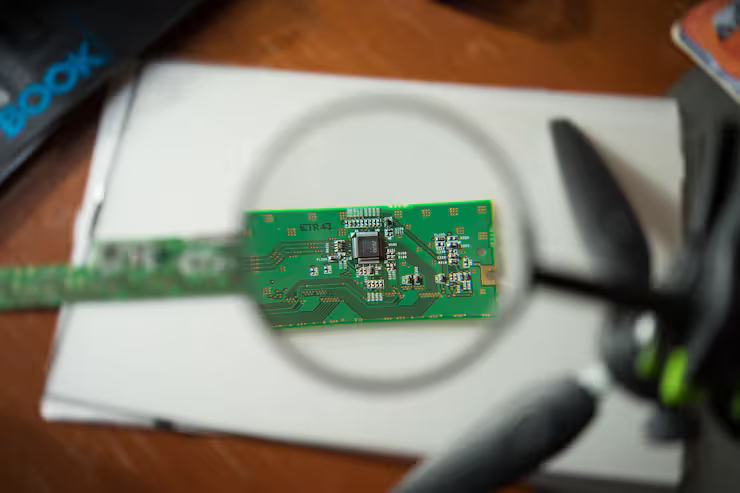
Microcontrollers play an important role in modern electronic systems by controlling operations, processing information, and responding to inputs from different devices. They are compact integrated circuits that combine a processor, memory, and input/output interfaces on a single chip. Unlike general-purpose computers, microcontrollers are commonly designed to perform specific tasks within electronic equipment. Their ability to operate with low power consumption, respond to signals, and control hardware makes them useful in industrial automation and automotive electronics.
In industrial environments, microcontrollers help operate machines, monitor equipment conditions, and manage production processes. In vehicles, they support functions such as engine management, lighting, temperature regulation, driver assistance, and electronic safety systems. As manufacturing facilities adopt smart technologies and vehicles incorporate more electronic features, microcontrollers have become an essential part of embedded systems engineering. Understanding their functions, types, applications, and design considerations helps explain how modern industrial equipment and automotive systems operate.
Importance of Microcontrollers in Modern Electronics
Role in Industrial Automation
Industrial automation uses electronic controllers, sensors, actuators, and software to manage machinery and production activities. Microcontrollers can process sensor readings, control motor operations, monitor temperatures, and manage communication between electronic components. For example, a temperature monitoring system can use a microcontroller to read a sensor and activate a cooling mechanism when a predefined limit is reached.
Microcontrollers also contribute to predictive maintenance and equipment monitoring. When connected to appropriate sensors and communication interfaces, they can collect information about vibration, temperature, pressure, and operating conditions. This information may help maintenance teams identify unusual patterns and investigate potential equipment problems before they cause significant disruption.
Role in Automotive Electronics
Automotive electronics rely on multiple electronic control units (ECUs) to manage different vehicle functions. Microcontrollers are frequently used inside these units to process information from sensors and control connected components. Applications include engine control, transmission management, anti-lock braking systems, airbag control, electric power steering, and body electronics.
Electric vehicles have expanded the role of embedded control systems. Battery monitoring, thermal management, motor control, charging systems, and energy management all depend on electronic hardware and software. The exact controller architecture varies according to the vehicle's design, performance requirements, and safety needs.
Main Components of a Microcontroller
Central Processing Unit and Memory
The central processing unit (CPU) executes instructions and performs calculations required by an embedded application. Its processing capability influences how quickly the microcontroller can respond to sensor inputs, execute control algorithms, and manage communication tasks. Microcontrollers also contain memory for storing program instructions and temporary operating data. Flash memory commonly stores firmware, while random-access memory (RAM) supports variables and data used during operation.
Input and Output Interfaces
Input and output interfaces allow a microcontroller to interact with external hardware. Digital input pins can detect signals from switches and sensors, while output pins can control indicators, relays, and other compatible electronic components. Analog-to-digital converters (ADCs) convert analog sensor signals into digital values that software can process. Pulse-width modulation (PWM) peripherals are frequently used for motor speed control, lighting regulation, and power electronics applications.
Communication Interfaces and Timers
Communication interfaces allow microcontrollers to exchange data with sensors, controllers, and other electronic devices. Common interfaces include UART, SPI, and I2C. Industrial and automotive systems may also use CAN, CAN FD, LIN, and industrial Ethernet-related technologies, depending on the device and system architecture. Timers and watchdog mechanisms support accurate event scheduling and help detect certain software execution problems.
Types of Microcontrollers Used in Industrial and Automotive Systems
8-Bit Microcontrollers
8-bit microcontrollers are commonly used in relatively simple control applications where limited processing power and memory are sufficient. Examples include basic sensor interfaces, indicator lights, switches, small appliances, and simple automotive body functions. Their architecture can be suitable for applications with straightforward control requirements, although the appropriate device depends on the required peripherals, operating conditions, and software complexity.
16-Bit Microcontrollers
16-bit microcontrollers provide greater data-processing capability than many basic 8-bit devices. They may be used in motor control, measurement equipment, power management, and other embedded control applications. Some families include specialized peripherals that support efficient timing, signal measurement, and control operations.
32-Bit Microcontrollers
32-bit microcontrollers are widely used in advanced industrial automation and automotive electronics. They can support more complex software, faster data processing, extensive communication interfaces, and advanced control algorithms. Applications include industrial motor drives, electronic control units, connected equipment, battery management, and selected driver assistance functions. Manufacturers such as Texas Instruments and NXP Semiconductors offer microcontroller families for industrial and automotive applications.
Applications of Microcontrollers in Industrial Automation
Industrial Motor Control Systems
Industrial motor control systems regulate the operation of pumps, fans, conveyors, compressors, and other machinery. A microcontroller can process feedback from current sensors, position sensors, and speed measurement devices to adjust motor operation. Depending on the application, it may implement speed regulation, torque control, fault detection, and communication with a supervisory controller.
Motor control applications often require predictable response times and careful handling of electrical noise. Engineers must therefore consider processing performance, timer resolution, analog measurement accuracy, and protection mechanisms when selecting an embedded controller.
Programmable Equipment and Process Monitoring
Microcontrollers can be integrated into monitoring devices that measure temperature, pressure, humidity, vibration, and flow. In manufacturing facilities, these measurements help operators understand equipment conditions and maintain process consistency. Microcontrollers may also support compact control systems that operate alongside programmable logic controllers (PLCs), industrial computers, or distributed control systems.
For complex machinery, a microcontroller does not necessarily replace a PLC. Instead, it may manage a specific subsystem, perform local data acquisition, or provide a dedicated interface between sensors and a larger automation network.
Industrial Internet of Things
The Industrial Internet of Things (IIoT) connects equipment, sensors, and software platforms so that operational data can be collected and analyzed. Microcontrollers with suitable connectivity can transmit measurements to gateways, monitoring systems, or cloud-based industrial platforms.
These systems can support remote condition monitoring, equipment utilization analysis, and predictive maintenance workflows. However, reliable IIoT implementation also requires suitable network architecture, cybersecurity controls, secure firmware updates, and careful management of sensitive operational data.
Applications of Microcontrollers in Automotive Electronics
Engine and Powertrain Management
In conventional vehicles, microcontrollers process information from engine sensors and help coordinate fuel injection, ignition timing, and other powertrain functions. Transmission controllers can also use sensor information to manage gear changes and operating behavior. These applications require consistent timing, dependable sensor processing, and suitable environmental protection.
Automotive microcontrollers are selected according to the control task, temperature range, processing needs, and applicable safety requirements. Some devices are designed for demanding under-the-hood environments where temperature and electrical disturbances can be significant.
Electric Vehicle Control Systems
Electric vehicles use embedded controllers for several functions, including battery monitoring, electric motor control, charging management, and thermal regulation. A battery management system (BMS), for example, monitors battery cell voltages and temperatures and estimates operating parameters. Its software may help identify abnormal conditions and coordinate protective responses through the wider vehicle system.
Microcontrollers also support electric motor control by processing position feedback, current measurements, and control commands. The choice of hardware depends on motor characteristics, switching requirements, communication needs, and functional safety considerations.
Vehicle Safety and Driver Assistance
Automotive electronic systems contribute to functions such as braking control, airbag deployment, steering assistance, and advanced driver assistance systems (ADAS). These functions can have different levels of safety criticality, so their controllers must be selected and developed according to the risks associated with each application.
Microcontrollers used in safety-related systems may incorporate watchdog timers, memory protection, diagnostic features, redundant processing resources, and other safety mechanisms. Automotive functional safety engineering commonly uses ISO 26262, while component qualification and environmental requirements must also be considered. A microcontroller's specifications alone do not establish that the complete vehicle system is safe; the overall hardware, software, integration, and validation process matters.
Key Differences Between Industrial and Automotive Microcontrollers
Industrial and automotive microcontrollers share many fundamental features, but their design priorities differ according to their operating environments and intended applications.
Feature | Industrial applications | Automotive applications |
|---|---|---|
Main purpose | Machine control and process automation | Vehicle control and electronic functions |
Typical operating environment | Factories, production lines, and industrial equipment | Vehicle interiors, engine compartments, and vehicle electronics |
Common communication | SPI, I2C, CAN, industrial networking interfaces | CAN, CAN FD, LIN, and automotive networking interfaces |
Important design priorities | Reliability, deterministic control, maintainability | Reliability, automotive qualification, functional safety |
Typical applications | Motor drives, sensors, process monitoring | Powertrain, body electronics, battery management |
Common concerns | Electrical noise, vibration, operating continuity | Temperature variation, vibration, electrical transients, safety |
The distinction is not absolute. Some microcontroller families support both industrial and automotive applications, but the specific device must meet the requirements of its intended environment.
Important Factors When Selecting a Microcontroller
Processing Performance and Memory
Engineers should assess the processing workload, memory requirements, peripheral count, and response-time constraints of the application. A simple monitoring device may require only a modest controller, while a complex motor drive or automotive ECU may need a higher-performance architecture with dedicated control peripherals.
Selecting excessive processing capacity can increase design complexity, while insufficient resources may limit future software development. A practical assessment should include current requirements, foreseeable updates, and available development tools.
Reliability, Temperature, and Functional Safety
Industrial and automotive environments can expose electronic devices to temperature changes, vibration, electrical interference, and power disturbances. Microcontrollers must be suitable for the expected conditions, and the surrounding circuit must provide appropriate power regulation, filtering, protection, and thermal management.
Safety-related applications require a more detailed engineering process. Automotive developers may evaluate ISO 26262 requirements and Automotive Electronics Council (AEC) component qualification, including AEC-Q100 where applicable. Industrial projects may consider relevant IEC standards and functional safety frameworks, depending on the application. Qualification of an individual component does not replace system-level verification.
Cybersecurity and Long-Term Support
Connected embedded systems can be exposed to unauthorized access, malicious firmware, and communication vulnerabilities. Security features such as secure boot, cryptographic hardware, access controls, and authenticated firmware updates may be important, especially in connected industrial and automotive products.
Long-term component availability, technical documentation, debugging tools, software libraries, and manufacturer support are also important selection factors. These considerations influence maintenance planning, product lifecycle management, and the ability to update embedded software over time.
Future Trends in Microcontrollers for Industrial and Automotive Electronics
Edge Computing and Intelligent Sensors
Edge computing allows electronic devices to process information close to where it is generated instead of sending every measurement to a remote server. More capable microcontrollers can perform local filtering, anomaly detection, and selected machine-learning tasks when their memory and processing resources are sufficient.
In industrial systems, this approach can reduce unnecessary network traffic and support faster local responses. In vehicles, embedded processing can help manage sensor information and coordinate electronic subsystems. More demanding workloads may still require specialized processors or dedicated accelerators.
Software-Defined Vehicles and Smart Manufacturing
Software-defined vehicles rely on increasingly flexible electronic architectures and software-controlled features. This development increases the importance of secure firmware updates, reliable communication, and software lifecycle management. Microcontrollers continue to handle many local control functions within these architectures.
Smart manufacturing is following a related path through connected sensors, automated equipment, digital monitoring, and data-driven maintenance. Microcontrollers provide a hardware foundation for many of these functions, although complete solutions also depend on networking, software platforms, industrial infrastructure, and system integration.
Energy Efficiency and System Integration
Energy-efficient electronics are important in battery-powered devices, electric vehicles, and industrial equipment. Microcontroller designers continue to develop lower-power operating modes, integrated peripherals, and architectures that combine multiple functions in a smaller footprint. These capabilities can help reduce component count and simplify certain designs, depending on the application.
Maintenance and Development Considerations
Microcontroller-based systems require ongoing attention to firmware quality, hardware condition, and operating performance. Developers should test software under normal and abnormal conditions, verify sensor readings, review fault logs, and confirm that communication interfaces behave as expected. Watchdog configuration, fault-handling routines, and controlled recovery procedures can improve system resilience when implemented appropriately.
In industrial environments, maintenance teams may also monitor electrical connections, cooling conditions, vibration, and power supply stability. Automotive embedded systems require structured verification, configuration management, and adherence to relevant development and safety processes. Firmware updates should be tested and authenticated, particularly where failures could affect equipment safety or vehicle operation.
Frequently Asked Questions
What is a microcontroller in industrial automation?
A microcontroller is a compact integrated circuit that processes inputs and controls electronic functions. In industrial automation, it can monitor sensors, regulate motors, manage equipment interfaces, and perform local control tasks.
Why are microcontrollers important in automotive electronics?
Microcontrollers help vehicles process sensor information and manage electronic functions such as engine operation, lighting, battery monitoring, climate control, and selected safety systems. They enable specialized control tasks to be performed within electronic control units.
Which microcontroller is suitable for industrial and automotive applications?
The appropriate microcontroller depends on processing requirements, memory, communication interfaces, environmental conditions, safety requirements, power consumption, and software support. A device intended for automotive use should have the necessary qualifications for its specific application.
What is the difference between a microcontroller and a microprocessor?
A microcontroller typically integrates a processor core, memory, and peripheral interfaces on one chip. A microprocessor generally emphasizes processing capability and may rely on external memory or additional components to build a complete system. The distinction varies across modern device architectures.
How do microcontrollers support predictive maintenance?
Microcontrollers can collect equipment measurements such as vibration, temperature, current, and pressure. When this data is analyzed over time, it can help identify unusual operating patterns and support maintenance decisions. Effective predictive maintenance also requires suitable sensors, analysis methods, and operational procedures.
Conclusion
Microcontrollers are a fundamental part of industrial automation and automotive electronics because they provide compact, programmable control for a wide range of electronic functions. Their applications include motor regulation, equipment monitoring, vehicle powertrain management, electric vehicle systems, and safety-related electronics. Different applications require different combinations of processing performance, memory, communication, reliability, and security.
As industrial equipment becomes more connected and vehicles incorporate increasingly sophisticated electronic architectures, microcontrollers will continue to support embedded control and data processing. Understanding their components, application requirements, and engineering limitations helps readers appreciate their role in modern manufacturing and transportation technologies.